
You've designed a game you believe in. Now comes the part nobody warned you about. The board game manufacturing process looks straightforward on paper — but every year, Kickstarter creators and publishing procurement leads discover the same hard truth: the decisions that determine your production outcome were already made (or missed) weeks before the factory started the run. This article maps those decisions so you can make them deliberately.
The board game manufacturing process moves from prototype through pre-production sampling to mass production — but it is not a simple linear sequence. Each stage locks in decisions that cannot be reversed without cost or delay. Understanding which specs must be confirmed before each stage begins is what separates a smooth delivery from an expensive reprint.

The sections below don't describe the manufacturing process step by step. Dozens of generic tutorials already do that. Instead, each section identifies a specific decision point, explains what's at stake if you get it wrong, and tells you the questions worth asking before you move forward.
What Does a Prototype Actually Tell a Factory?
Most first-time buyers treat the prototype as a creative milestone — proof that the game works. That's reasonable from a design perspective. From a manufacturing perspective, however, a prototype without locked specifications tells a supplier almost nothing actionable.
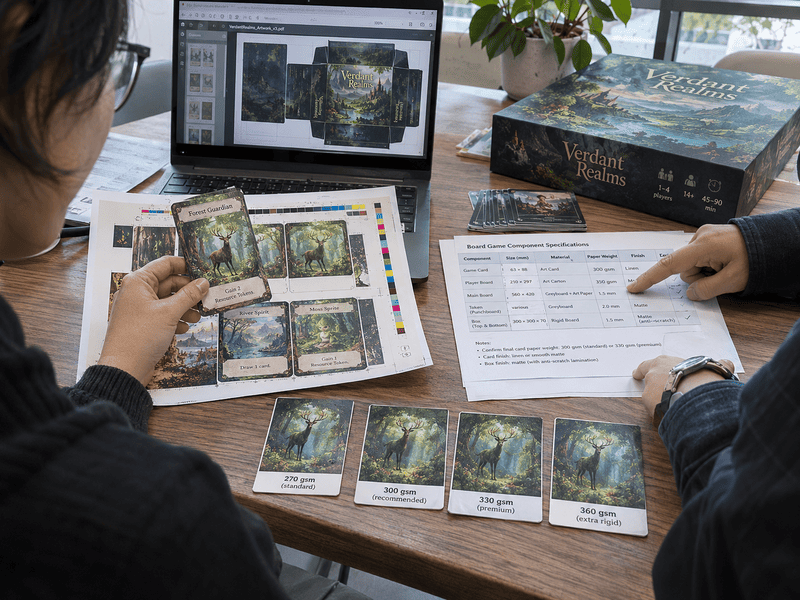
A prototype in the context of board game manufacturing serves one primary function: surfacing spec conflicts before they enter production.[^1] If your prototype hasn't been reviewed against factory material tolerances, color output capabilities, and component fit constraints, it is a design document — not a manufacturing spec.
Designer's Prototype vs. Factory-Approved Prototype
These are two different objects. Here's what distinguishes them:
| Feature | Designer's Prototype | Factory-Approved Prototype |
|---|---|---|
| Purpose | Gameplay testing, visual proofing | Manufacturing spec confirmation |
| Materials used | Whatever is available locally | Factory's actual production materials |
| Color output | Home printer or local print shop | Factory's calibrated press profile |
| Component tolerances | Not checked | Verified against die-cut and insert fit |
| Approval status | Internal sign-off | Client and factory both sign off |
The gap between these two is where most production problems are born.
When clients come to us with a prototype produced at a local print shop, the first thing we do is compare their color expectations against what our presses can actually output on the specified stock. It's not unusual to find a 15–25% perceptual difference in saturated colors when moving from a home printer to an offset press[^2] — especially in dark blues, deep reds, and gradients. If that isn't caught at the prototype stage, it becomes a dispute at delivery.
What We Check Before Approving a Prototype
Here are the specific questions we raise internally — and with the client — before treating a prototype as factory-approved:
- Color profile: Is the artwork supplied in CMYK or RGB? What's the target color space? Has the client been shown a press proof?
- Card stock weight and coating: Does the prototype use the same GSM and lamination as the production run? If not, the feel and durability will differ.
- Component fit: If the game includes a tray insert, do all components fit with production tolerances (not prototype tolerances)?
- Die-cut registration: Are the cut lines stable across the full sheet, or were they hand-trimmed on the prototype?
- Bleed and safe zone compliance: Are all files print-ready, or will they need preparation work before plating?
None of this is about finding fault with the client's design. It's about catching problems when they're still free to fix.
Which Production Decisions Are Irreversible Mid-Run?
This is the question most buyers don't think to ask until it's too late.
The board game manufacturing process involves several decision windows — periods during which a spec can still be changed without significant cost. Miss those windows, and the same change becomes expensive or simply impossible.
Once a production run begins, card stock selection, box construction type, print quantity, and color profiles are locked.[^3] Component sourcing decisions — especially for custom accessories like tokens, dice, and wooden pieces — must be finalized before tooling or procurement begins. Changes made after these lock-in points typically trigger reprints, remakes, or delayed delivery.
The Decision Lock-In Map
| Decision | Last Window to Change | Cost of Late Change |
|---|---|---|
| Paper/card stock weight | Before pre-production sample approval | Reprint entire affected component |
| Box style and dimensions | Before box dieline is finalized | New dieline + possible insert redesign |
| Print quantity | Before plates are made | MOQ may apply to any increase; decreases often not possible |
| Component materials (tokens, inserts) | Before procurement / tooling begins | Full component remake |
| Color profile | Before pre-production sample sign-off | Reprint if plates are already made |
| Finishing (lamination, foil, spot UV) | Before pre-production sample | Setup cost applies to any change |
The clients who navigate this best are the ones who come to us with a component list that's already been reviewed — not just a completed game file. When a Kickstarter creator arrives with a finalized artwork package but no component spec sheet, we spend the first consultation building that list together. That conversation has to happen before anything enters production.
How Is Board Game Manufacturing Actually Priced?
If you've received a quote and assumed it was a fixed price, it probably wasn't.
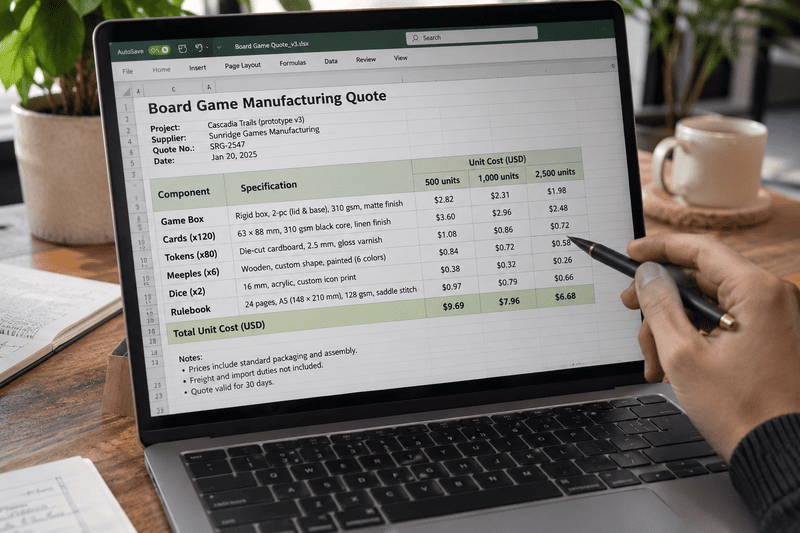
Board game manufacturing cost is a variable built from a combination of factors that interact with each other. Changing one element — say, switching card stock weight — can alter not just that component's cost but also the box dimensions required, which affects shipping weight, which affects landed cost.
Board game printing cost is determined by component mix, print quantity, material specifications, and accessory sourcing — not by a standard per-unit rate. MOQ thresholds, one-stop component procurement versus print-only service, and finishing choices all shift the final number. Treat the first quote as a starting estimate, not a commitment.
What Shifts the Price
Print quantity is the most obvious lever. The per-unit cost at 500 copies can be three to four times the per-unit cost at 3,000 copies for the same game[^4]. This isn't unique to board games — it reflects plate setup and press time amortization across a larger run.
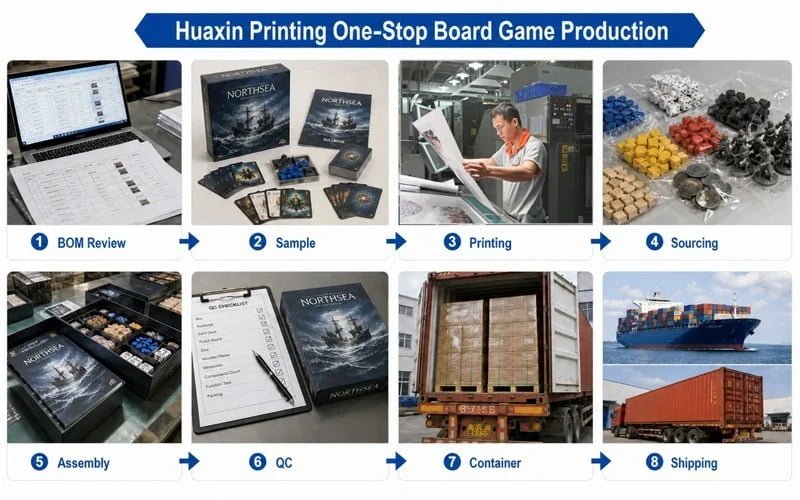
Component sourcing is less obvious but equally significant. A print-only supplier delivers printed components and leaves the rest to you: tokens, dice, card sleeves, rubber bands, custom inserts. You then source those separately and coordinate consolidation yourself. A supplier that handles component procurement as part of the same project — the way we operate at Huaxin Printing — changes the cost structure. Accessories are sourced at volume, consolidated in one location, and packed together. The comparison isn't just convenience; it affects per-unit landed cost, coordination overhead, and the risk of mismatched lead times between printed and non-printed components.
Finishing choices — spot UV, foil stamping, embossing, soft-touch lamination — are add-on setup costs, not simply per-unit additions. Each requires a separate setup run. Stacking multiple finishes on one component (say, foil plus spot UV on a box lid) compounds both setup time and cost.
Artwork preparation status also affects price indirectly. Files that require pre-press correction, color conversion, or bleed adjustment consume production time that gets priced in somewhere.
How Do You Verify What a Supplier Promises?
This is the central concern for every buyer working with a supplier they haven't used before — especially across borders.
The honest answer is that no single checkpoint guarantees delivery quality. But a structured sequence of verification points creates a paper trail and a set of agreed references that protect both sides.
To verify a board game manufacturer's claims, buyers should request and approve a physical pre-production sample (PPS) before authorizing mass production. This sample should use the actual production materials, not substitutes. QC sign-off should reference specific measurable criteria: color delta, card calliper, component fit, and packaging seal integrity.
The Three Checkpoints That Matter
1. Prototype Approval (before pre-production)
At this stage, you're confirming that the factory has understood your specs and can approximate them in materials. Key questions:
- Were the sample materials the same grade specified in the quote?
- Does the printed color match the digital proof within an acceptable range?
- Has the factory flagged any components it cannot source or produce as specified?
2. Pre-Production Sample (PPS) Approval
This is the most important checkpoint — and the one most commonly skipped by buyers in a hurry. A PPS is produced from the actual production materials, using the actual press setup. What you approve here is what will be manufactured at scale.
Questions to ask at this stage:
- Is every component present in the PPS, including accessories?
- Are card dimensions within tolerance across the full deck sample?
- Does the box close cleanly with all components inside, including packing material?
- Are color-critical elements (box art, card backs) consistent across multiple copies in the sample?
At Huaxin Printing, we don't release a PPS without an internal check against the approved proof — but we also walk the client through the specific items we checked, so the approval isn't just a signature on a photo.
3. Pre-Shipment QC
Before the production run ships, a final inspection against the approved PPS should be conducted. This can be done by the factory's internal QC team, but many buyers — particularly larger publishing procurement leads — engage a third-party inspection service (SGS, Bureau Veritas, and similar) for an independent check[^5].
What pre-shipment QC should cover:
- Random carton inspection from multiple pallet positions
- Component count per unit (against the packing list)
- Visual inspection of print quality, lamination adhesion, and die-cut accuracy
- Packaging condition: no damp, crush, or seal failure
Frequently Asked Questions
What is the difference between a prototype and a pre-production sample?
A prototype is a designer's proof used to test gameplay and visuals, often produced on materials that differ from production specs. A pre-production sample (PPS) is produced by the factory using the actual production materials and press setup. The PPS is the reference document for the mass production run — the prototype is not.
How long does the board game manufacturing process take from prototype to delivery?
Timelines vary significantly by project complexity, component mix, and order quantity. As a general reference, a straightforward game with standard components might take 45–70 days from approved PPS to shipment[^6]. Projects with custom accessories, foil finishes, or large quantities take longer. No reputable supplier should quote a fixed timeline before specs are confirmed.
What is the typical minimum order quantity (MOQ) for board game printing?
MOQ depends on the supplier and the product mix. For offset printing of board games, 500 units is a common lower threshold[^7], though some suppliers require more. Digital printing can accommodate smaller runs but at higher per-unit cost.[^8] Component accessories may carry separate MOQs that affect the overall minimum viable order.
Can I change the component list after I've received a quote?
Yes, but expect the quote to change with it. Component changes — especially additions — may affect box dimensions, weight, shipping cost, and lead time. Changes made after pre-production sample approval may require new setup work and additional charges. Lock your component list before confirming your order.
How do I evaluate a Chinese board game manufacturer I haven't worked with before?
Request a physical sample of a comparable product they've previously produced. Ask for the specific materials used in that sample. Ask how they handle color discrepancies at PPS stage. Check whether they can supply documentation for certifications you require (EN71, ASTM F963, FSC[^9], etc.) and treat those documents as items to verify independently, not as guarantees.
Conclusion
The board game manufacturing process is not a factory problem — it's a decision sequence that begins the moment you start working with a supplier. What gets locked in at the prototype stage, what gets confirmed at the pre-production sample, and what gets verified before shipment collectively determine whether your finished game matches what you imagined. Skipping any of those checkpoints shifts risk onto you.
The buyers who consistently receive good outcomes are the ones who arrive with specific questions, not just artwork files. They know which specs they're committing to, they read the PPS against their proof, and they treat the QC stage as a final reference — not a formality.
If you're preparing for your first or next print run and want to work with a supplier who can handle both printing and component sourcing under one roof, Huaxin Printing works with Kickstarter creators and publishing procurement teams across the US, UK, Europe, and Australia. Reach out with your component list and we'll walk through the spec questions together — before anything gets locked in.
[^1]: "An Introduction to the Engineering Design Process", http://radlab.byu.edu/prototyping.html. Product development and design-for-manufacturing literature consistently identifies specification validation as a core function of pre-production prototyping, with the prototype serving as a physical test of whether design parameters are achievable within the constraints of the intended manufacturing process. Evidence role: definition; source type: education. Supports: That in manufacturing and product development contexts, prototypes serve a specification validation function — identifying conflicts between design intent and production constraints before committing to tooling or full production.. Scope note: The article's claim that this is the 'primary' function is a manufacturing-centric framing; in broader product development literature, prototypes also serve user testing, stakeholder communication, and iterative design functions. [^2]: "Perceptual and Relative Colorimetric are the two rendering ...", https://www.facebook.com/acdsee/videos/perceptual-and-relative-colorimetric-are-the-two-rendering-intents-youll-use-for/4433683776874538/. Research on color gamut mapping and ICC profile conversion documents measurable perceptual differences between RGB desktop output and CMYK offset press reproduction, with saturated blues and reds among the most affected hues due to gamut boundary compression. Evidence role: mechanism; source type: research. Supports: That significant perceptual color differences exist between home/desktop inkjet output and commercial offset printing, particularly in saturated hues, due to differences in color gamut and ink behavior.. Scope note: Published studies typically report gamut volume differences rather than a single perceptual percentage range; the 15–25% figure cited in the article may reflect practitioner experience rather than a standardized measurement. [^3]: "Offset printing", https://en.wikipedia.org/wiki/Offset_printing. Offset lithography production workflows require color separations and plates to be produced from finalized files before press runs begin; once plates are made and press makeready is complete, changes to color profiles, substrate, or quantity require new plates and setup, generating costs proportional to the stage at which the change is requested. Evidence role: mechanism; source type: education. Supports: That offset printing production workflows create hard specification lock-in points at plate-making and press setup stages, after which changes to color, substrate, or quantity require new plates, new makeready, or additional press runs.. Scope note: Digital printing workflows have different and more flexible lock-in points; the article's lock-in claims apply specifically to offset production, which is the dominant method for board game print runs above approximately 500 units. [^4]: "A method of minimising paper requirements for offset printing", https://bioresources.cnr.ncsu.edu/resources/a-method-of-minimising-paper-requirements-for-offset-printing/. Printing economics literature establishes that fixed prepress and plate setup costs are amortized across the total print run, causing per-unit costs to fall steeply at lower quantities and flatten at higher volumes — a relationship that can produce large unit-cost ratios between small and large runs. Evidence role: mechanism; source type: education. Supports: That per-unit printing costs decrease substantially as print quantity increases, due to fixed setup and plate costs being amortized across a larger run.. Scope note: The specific 3–4× ratio cited in the article depends on the fixed-to-variable cost structure of a particular supplier and component mix; published sources support the general principle but not this precise multiplier. [^5]: "Toy Safety Business Guidance", https://www.cpsc.gov/Business--Manufacturing/Business-Education/Toy-Safety. SGS and Bureau Veritas are among the largest internationally accredited testing, inspection, and certification organizations; both operate pre-shipment inspection services for consumer goods manufactured in China and are commonly referenced in import compliance and supply chain management literature. Evidence role: general_support; source type: institution. Supports: That SGS and Bureau Veritas are internationally recognized third-party testing and inspection organizations used across consumer goods manufacturing supply chains, including toy and game production.. Scope note: The article does not specify which inspection protocols are most relevant to board game components; buyers should confirm that the chosen inspection body has experience with printed goods and toy-category products. [^6]: "How Long Does it Take to Make a Boardgame? : r/Eve", https://www.reddit.com/r/Eve/comments/19etjzi/how_long_does_it_take_to_make_a_boardgame/. Tabletop game publishing guides and crowdfunding production resources commonly cite production-to-shipment timelines of 45–90 days for standard board game runs manufactured in China, with variation driven by component complexity, finishing requirements, and factory scheduling. Evidence role: general_support; source type: institution. Supports: That board game production timelines from approved sample to shipment typically fall within a range of several weeks to a few months depending on complexity and quantity.. Scope note: Published timelines are typically drawn from creator reports and publisher guides rather than controlled manufacturing studies; actual lead times depend heavily on factory capacity and order queue at the time of production. [^7]: "Board Game Manufacturers with small minimum quantity?", https://www.reddit.com/r/BoardgameDesign/comments/1eoyvjr/board_game_manufacturers_with_small_minimum/. Industry procurement guides and game publisher resources frequently cite minimum order quantities of 500–1,000 units as typical for offset-printed board games manufactured in China, reflecting the threshold at which setup costs become economically viable per unit. Evidence role: general_support; source type: institution. Supports: That offset-printed board games commonly carry minimum order quantities in the range of several hundred units, reflecting the economics of press setup costs.. Scope note: MOQ thresholds vary by supplier, component complexity, and market conditions; no single authoritative industry body publishes a standardized MOQ figure for board game printing. [^8]: "The cost crossover point between offset and digital", https://www.ricoh-usa.com/en/production-printing/resources/articles/the-cost-crossover-point-between-offset-and-digital. Print production economics literature establishes that digital printing eliminates plate and makeready costs but incurs higher per-impression costs than offset, resulting in a crossover quantity — typically cited between 500 and 2,000 units depending on substrate and format — below which digital printing is more economical and above which offset printing offers lower per-unit cost. Evidence role: mechanism; source type: education. Supports: That digital printing carries lower setup costs than offset printing but higher per-unit variable costs, making it more economical at low quantities while offset printing becomes more cost-effective above a crossover quantity that depends on job specifications.. Scope note: The crossover quantity varies significantly by job size, substrate, color coverage, and equipment; the figures cited in the literature are illustrative rather than universally applicable to board game component printing. [^9]: "ASTM F963 Requirements", https://www.cpsc.gov/Business--Manufacturing/Business-Education/Toy-Safety/ASTM-F-963-Chart. EN71 is the European toy safety standard administered under EU directive 2009/48/EC; ASTM F963 is the US Consumer Product Safety Improvement Act-referenced standard for toy safety; FSC (Forest Stewardship Council) certification governs chain-of-custody for paper and board materials. Evidence role: definition; source type: government. Supports: That EN71 and ASTM F963 are the primary toy safety standards governing products sold in the European Union and United States respectively, and that FSC certification applies to paper and board materials sourced from responsibly managed forests.. Scope note: Compliance requirements vary by product category, target age group, and destination market; buyers should consult the relevant regulatory body or a certified testing laboratory to confirm which standards apply to their specific product.