

Choosing a board game manufacturer in China feels straightforward until your shipment arrives — missing components, washed-out colors, or a safety certification failure that blocks your product at customs. The stakes are high. A wrong supplier choice can cost you months of lead time and thousands of dollars in rework. The right framework turns this risk into a manageable decision.
Choosing a board game manufacturer in China is not a price negotiation problem — it's a capability-matching problem. The right supplier must handle every component your game requires, at your batch size, to the safety standards your target market demands. A cheap quote that fails on any of these three dimensions will almost certainly cost more than the money it appeared to save.

Most buyers start by collecting quotes. That's the wrong first step. Before you contact a single factory, you need a framework. The sections below break down exactly what to evaluate — and why each factor matters more than price.
Does the Supplier Actually Have Full-Component Capability?
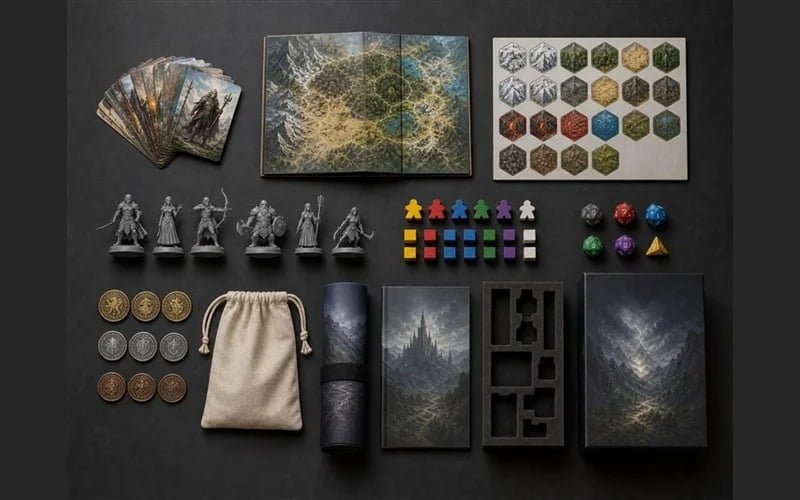
Most Chinese print factories are exactly that: print factories. They handle cards and rulebooks without difficulty. But a board game is rarely just printed paper. The moment your game includes custom tokens, dice, insert trays, vacuum-formed plastic components, or a specialty rigid box, you've moved outside the core competency of a large share of the market.
Full-component capability is rare — not assumed. When we assess a new project at our factory, the first thing we verify is whether every item on the component list has a confirmed production or sourcing path. A "yes, we can do it" response to a component checklist is not enough. Ask for specifics.
Why "One Factory, One Supplier" Matters for Your Project
When a supplier outsources components to sub-vendors they don't manage directly, accountability disappears.[^1] Delays in one component hold up your entire shipment. Quality inconsistencies between vendors are hard to catch before final assembly. And when something goes wrong, the finger-pointing starts.
Clients have come to us after experiencing exactly this: they worked with a low-cost print vendor who subcontracted the insert tray and the custom dice to separate factories with no coordination. The result was a three-week delay and a tray that didn't fit the box dimensions printed by the main vendor.
Here's what a component-by-component evaluation should look like:
| Component | Questions to Ask |
|---|---|
| Cards (poker, tarot, custom sizes) | What stock weights and coatings are available in-house? |
| Game boards (folded or mounted) | What maximum print dimensions? Lamination options? |
| Custom tokens (wood, cardboard, plastic) | Are these manufactured or sourced? Lead time? MOQ per shape? |
| Dice | Standard or custom? Can they provide safety test reports? |
| Insert trays | Vacuum-formed or cardboard? Who produces them? |
| Game box | Rigid set-up box or folding carton? In-house or outsourced? |
| Rulebook / Booklets | In-house prepress and printing? |
A supplier who can answer every row of that table with specifics — not vague reassurances — is a supplier worth taking seriously. Huaxin Printing is one example of a manufacturer that provides this kind of one-stop production service, covering printed components and physical accessories under one roof.
Is the Price Quote Realistic, or Is It a Safety Red Flag?
Low prices feel like wins. In board game manufacturing, an abnormally low quote is often a warning sign — not a negotiation starting point.
Safety compliance has a real cost. Materials that meet CE, ASTM F963, EN71, or equivalent standards cost more than non-compliant alternatives. Process controls, documentation, and third-party testing add further cost. Suppliers who underbid significantly are frequently cutting exactly these line items.
A product that fails safety testing at the port of entry cannot enter the market. The "cheapest" quote can become the most expensive outcome.
Understanding the Safety Certification Landscape
I want to be clear here: I'm not a regulatory authority, and specific requirements vary by product type, age rating, and destination market. What I can tell you from working with international clients is this — always verify your compliance requirements with your importer of record or a qualified compliance consultant before signing a production agreement.
That said, here is a general orientation:
- Products entering the US market are often subject to ASTM F963 (toy safety) if they carry an age rating. Verify with your importer.
- Products entering EU / UK markets typically involve CE marking and may reference EN71. Verify with your compliance consultant.
- Products for Australia and other markets have their own frameworks. Don't assume US/EU documentation transfers automatically.
When you ask a potential supplier about safety compliance, the right response is not "yes, we comply." The right response is showing you test reports from a recognized third-party lab (SGS, Intertek, Bureau Veritas, etc.) for comparable products. A supplier who cannot produce these documents is a supplier who cannot prove compliance.
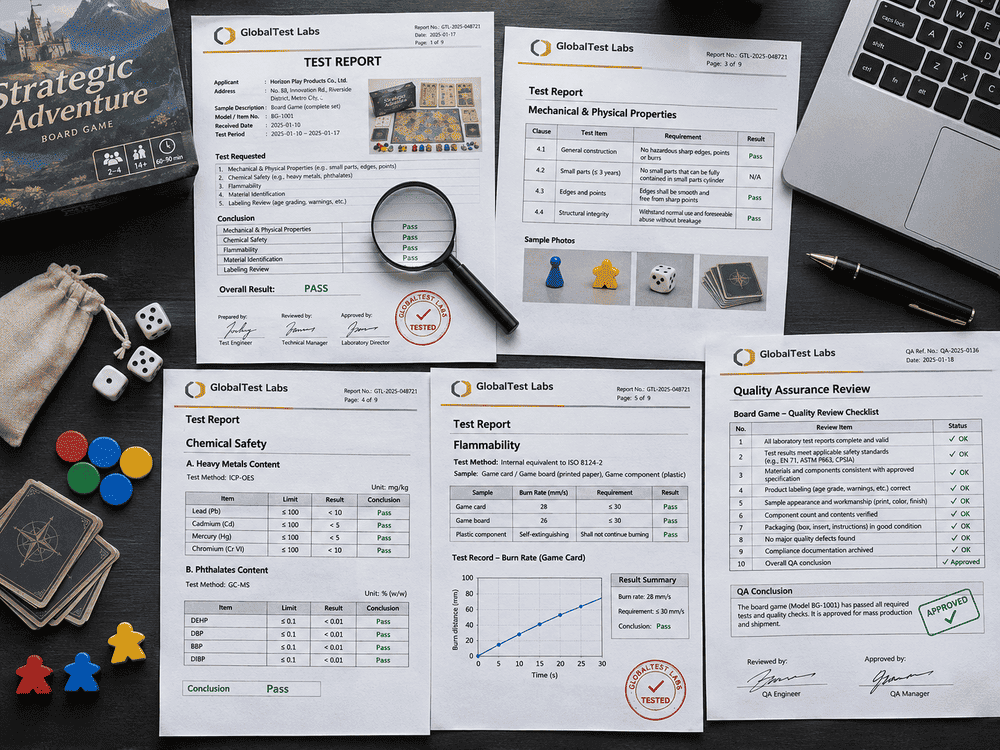
[AI Image Prompt: A clean, professional flat-lay image on a dark desk surface. Show printed laboratory test reports with logos similar to SGS or Intertek (generic, not exact), next to board game components like dice and small tokens. Add a magnifying glass on one report, a pen, and a laptop partially visible in the corner. The mood should feel like a quality assurance review meeting. Neutral, professional color palette.]
Does the Supplier's MOQ Match Your Actual Volume?
This is the problem no one talks about openly, but it derails more Kickstarter projects than any other single factor.
Large factories operate at scale. Their economics are built around long print runs. A 500-unit Kickstarter campaign is not interesting to a factory with a 3,000-unit MOQ — and even if they accept the order, small batches often get deprioritized in the production queue when a larger client's job arrives.
For Kickstarter and Crowdfunding Creators
If you are a first-time board game creator launching via crowdfunding, you need to match your realistic volume to the right supplier tier before sending a single inquiry. Here's a practical way to think about it:
Typical production volume tiers and considerations:
- Under 500 units: Very limited factory options in China. Digital printing becomes more cost-effective. Per-unit costs will be high. Manage expectations.
- 500–2,000 units: The target range for most Kickstarter projects. Look for mid-sized specialized game manufacturers with confirmed MOQs in this range. Ask explicitly.
- 2,000–5,000 units: Suitable for a wider range of factories. Offset printing becomes economical. More negotiating leverage.
- 5,000+ units: Standard commercial territory. Large factories, competitive pricing, full offset print runs.
Beyond MOQ, crowdfunding creators should ask about tooling costs. Custom die shapes, custom dice faces, and vacuum-formed trays often require upfront tooling investment.[^2] This cost is separate from the per-unit price. Get it itemized in your quote.
Huaxin Printing works with both publisher procurement teams and smaller-batch crowdfunding creators — it's worth having a direct conversation about volume and timeline before assuming a fit or a mismatch.
How Do You Evaluate Print Quality Before Committing?
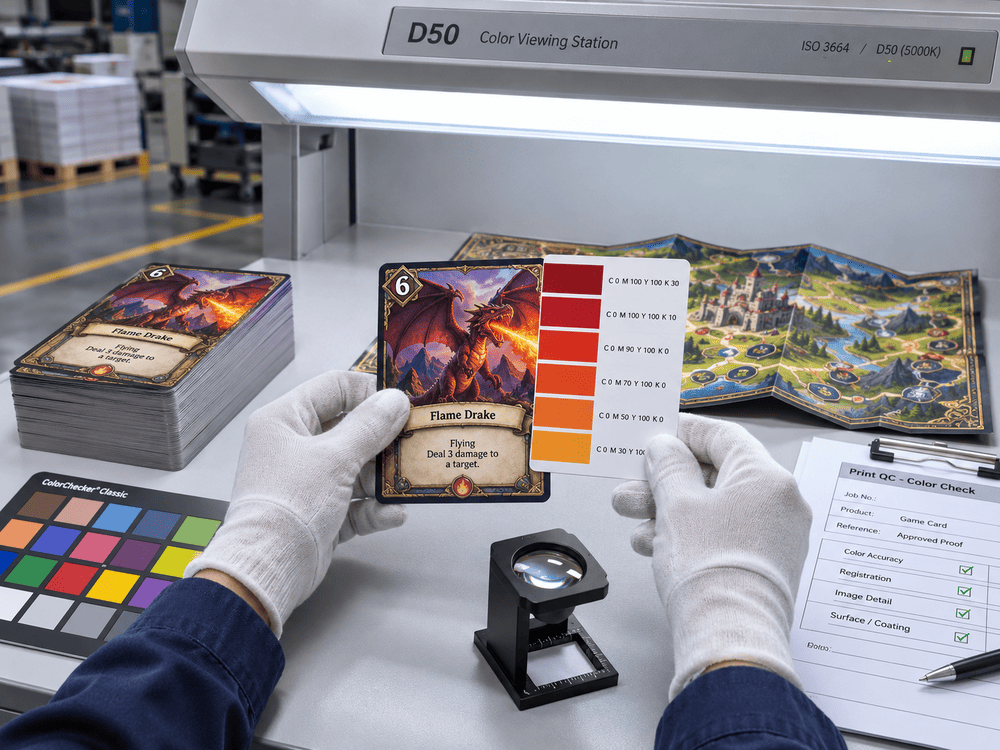
Print quality is visible and testable. Most buyers just don't know what to look for. This is where a supplier's color management capability separates professional manufacturers from commodity printers.
Color management is one of our core strengths at our factory. We work with clients globally — publishers in the US, UK, Germany, France, and Australia — who need consistent, accurate color across full print runs. A game board with illustration that prints muddy or dull is not just aesthetically disappointing. It can undermine the entire product experience.
Here's a concrete checklist for evaluating print samples from any potential supplier:
Print Quality Evaluation Checklist
Color accuracy:
- Does the printed sample match your digital file (viewed on a calibrated monitor) without obvious color shifts?
- Are skin tones, shadow areas, and saturated colors all rendered accurately?
- Ask if the factory uses ICC profiles and whether they work to a verified print standard (e.g., ISO 12647).
Consistency across a run:
- Request samples from different positions in the same print run (beginning, middle, end of sheet).
- Color drift across a run is a production control problem, not a proofing problem.[^3] These are different.
Card stock and lamination:
- Check the stated GSM against a reference. A supplier claiming 310 GSM poker cards should be able to verify this.[^4]
- Test lamination durability: rub the surface firmly, check for peeling or delamination at edges.
- Check for curl on cards left flat for 24 hours in normal room conditions.
Game board:
- Fold the board repeatedly. Check that the fold line doesn't crack the printed surface.
- Examine edge definition on illustrated maps. Soft or blurred edges indicate inadequate prepress or registration problems.
Box construction:
- Rigid set-up boxes should have corners that meet cleanly with no gap or overlap.
- Check that lid and base fit snugly — not too tight, not loose.
What Does a Reliable Factory Relationship Actually Look Like?
Capability is necessary. Reliability in communication and project management is what turns capability into a delivered product.
Clients have come to us after working with suppliers who went silent for three weeks mid-production, or who confirmed specifications verbally and then shipped to a different spec. Communication failure is a production failure.
When you evaluate a supplier, pay attention to these signals:
- Response time during inquiry: A supplier who takes five days to answer a quote request will probably take five days to answer a production question.[^5] Speed of communication during sales reflects operational culture.
- Specification documentation: Does the supplier issue a written production spec sheet that you sign off on before production begins? If not, your approval is verbal — and verbal agreements don't hold in a dispute.
- Sampling process: A professional manufacturer will produce a pre-production sample (PPS) before the full run. Skipping this step is a red flag.[^6]
- Proactive problem-raising: Good suppliers tell you when a specification is technically problematic — before production, not after. If a supplier accepts every requirement without comment, be cautious.
Frequently Asked Questions
What is a realistic MOQ for board game manufacturing in China?
MOQ varies by supplier and component type. Many mid-sized specialized manufacturers accept orders from 500 to 1,000 units for complete games. Larger factories may require 2,000 to 5,000 units. Always confirm MOQ explicitly before requesting a detailed quote, and ask whether tooling costs apply to your component list.
How long does production typically take for a board game order from China?
Standard lead time for a complete board game — including sampling, approval, and full production — typically runs 45 to 75 days from approved specifications.[^7] Complex games with custom components or specialty finishes may take longer. Always build buffer time into your project schedule, especially for crowdfunding fulfillment deadlines.
Should I use a sourcing agent or contact a factory directly?
Both approaches work. Sourcing agents add a coordination layer that is useful if you are managing multiple suppliers or navigating your first China procurement. Working directly with a factory that offers one-stop capability — like Huaxin Printing — removes the intermediary and can simplify communication, accountability, and cost management.
How do I verify that a factory can meet safety requirements for my market?
Ask the factory to provide third-party lab test reports (from labs such as SGS, Intertek, or Bureau Veritas) for comparable products they have produced. Then verify your specific requirements with your importer of record or a qualified compliance consultant. Do not rely on a factory's verbal assurance of compliance as a substitute for documented test reports.
Can Chinese manufacturers handle the custom component variety that modern board games require?
Some can. Many cannot. The distinction is between print-focused factories and full-service game manufacturers. A factory with in-house component sourcing — covering dice, tokens, insert trays, and specialty boxes alongside printed elements — can manage this. Always request a line-item breakdown of how each component in your game will be produced or sourced, and by whom.
Conclusion
Choosing a board game manufacturer in China comes down to three questions: Can this supplier handle every component my game requires? Can they deliver to the safety standards my market demands? And is their production scale a real match for my order volume? Price matters — but only after these three questions are answered. A supplier who fails on capability, compliance, or scale will cost you far more than any savings on the quote. Request samples, ask for documented test reports, get specifications in writing, and confirm component sourcing line by line.
If you are a publisher procurement manager or a Kickstarter creator evaluating your options, Huaxin Printing offers full in-house production from prepress through finishing, one-stop component sourcing, and direct experience serving clients in the US, UK, Europe, and Australia. Reach out with your component list and target volume — a specific conversation is always more useful than a general inquiry.
[^1]: "Outsourcing decision in manufacturing supply chains ...", https://www.academia.edu/102078217/Outsourcing_decision_in_manufacturing_supply_chains_considering_production_failure_and_operating_costs. Supply chain management literature on multi-tier supplier relationships identifies reduced visibility into sub-vendor operations as a source of quality risk; research on supply chain transparency documents that buyers who lack direct relationships with sub-tier suppliers face greater difficulty detecting and resolving quality and delivery failures. Evidence role: mechanism; source type: research. Supports: That lack of direct oversight over sub-tier suppliers in manufacturing supply chains creates quality coordination risks and reduces buyer accountability. Scope note: The research base on multi-tier supply chain risk is primarily drawn from automotive, electronics, and apparel industries; direct empirical evidence specific to board game or specialty print manufacturing sub-contracting is limited. [^2]: "I keep hearing it's expensive to have custom molded dice ...", https://www.reddit.com/r/tabletopgamedesign/comments/1vynqp/i_keep_hearing_its_expensive_to_have_custom/. In injection molding and vacuum forming processes, production of custom-shaped components requires the prior fabrication of a mold or forming tool; this tooling represents a fixed capital cost that must be recovered before or alongside per-unit production costs, a standard cost structure in plastics manufacturing documented in manufacturing engineering literature. Evidence role: mechanism; source type: education. Supports: That custom plastic components including dice and vacuum-formed trays require the fabrication of molds or forming tools before production can begin, and that these tool costs are incurred independently of per-unit material and labor costs. [^3]: "Maintaining Print: Keeping the Same Color Over Time", https://idealliance.org/maintaining-print-keeping-the-same-color-over-time/. ISO 12647-2, the international standard for offset lithographic printing, specifies tolerances for color consistency across a print run and attributes within-run variation to press parameters including ink density, dot gain, and substrate consistency rather than to pre-press proofing processes. Evidence role: mechanism; source type: institution. Supports: That color variation within a single print run reflects press control and ink density management issues rather than pre-press or proofing deficiencies. Scope note: The standard addresses commercial offset printing broadly; its specific application to short-run board game printing may vary depending on press type and factory certification status. [^4]: "Grammage", https://en.wikipedia.org/wiki/Grammage. Grammage expressed in grams per square meter (g/m²) is the internationally standardized measure of paper and paperboard substance, defined under ISO 536; it is a primary specification in paper and board procurement and provides a verifiable basis for confirming that supplied materials meet contracted weight specifications. Evidence role: definition; source type: institution. Supports: That GSM (grams per square meter) is a standardized measurement of paper and board weight, and that it is a verifiable specification governed by international standards. [^5]: "Proactive Supply Chain Performance Management with ... - PMC", https://pmc.ncbi.nlm.nih.gov/articles/PMC4214046/. Supply chain management research on supplier selection criteria identifies communication responsiveness as a proxy indicator for operational reliability; studies on buyer-supplier relationships suggest that pre-contract interaction quality correlates with post-contract performance, though the relationship is not deterministic. Evidence role: general_support; source type: research. Supports: That supplier responsiveness during pre-contract interactions is a meaningful indicator of operational communication quality during production. Scope note: The predictive relationship between pre-sale response time and production communication is a heuristic supported by practitioner experience and general supplier management literature rather than by controlled empirical studies specific to the board game manufacturing context. [^6]: "Q7A Good Manufacturing Practice Guidance for Active ...", https://www.fda.gov/regulatory-information/search-fda-guidance-documents/q7a-good-manufacturing-practice-guidance-active-pharmaceutical-ingredients. Quality management frameworks including the Production Part Approval Process (PPAP) used in automotive supply chains and first-article inspection (FAI) procedures in aerospace and general manufacturing establish pre-production verification as a standard mechanism for confirming that production processes will meet specifications before full-run commitment. Evidence role: expert_consensus; source type: institution. Supports: That pre-production sampling or first-article inspection is a recognized quality management practice in manufacturing intended to verify specifications before full production runs commence. Scope note: PPAP and FAI are formal frameworks developed for high-volume industrial manufacturing; their direct applicability to board game production is contextual, though the underlying principle of pre-run verification is broadly applicable across manufacturing sectors. [^7]: "Where to produce a game: Europe or China?", https://www.facebook.com/groups/boardgamerevolution/posts/4403166346641936/. Industry guides and crowdfunding creator resources commonly cite production lead times of six to twelve weeks for complete board games manufactured in China, a range broadly consistent with the 45–75 day figure stated in the article. Evidence role: general_support; source type: other. Supports: That board game production lead times from Chinese manufacturers typically fall within a 45–75 day range from specification approval to completion. Scope note: Published lead time figures vary considerably by source and reflect averages; actual timelines depend on order complexity, factory capacity, and component sourcing, and no single authoritative industry benchmark exists for this metric.