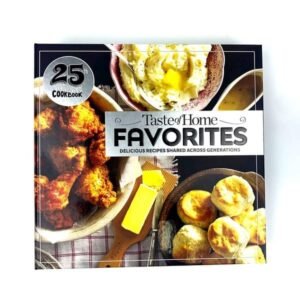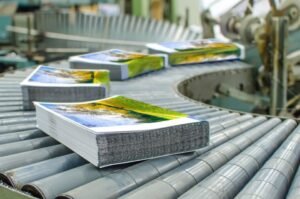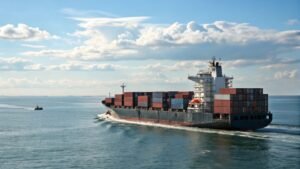

The cost to print 1,000 books in China depends on six variables that work together: paper, binding, size, printing method, finishing, and logistics. If you lock quantity first, you may overpay. Define the use case and budget, then trade off these variables to get the best outcome for your title and timeline.
There is no single number. The cost to print 1,000 books in China is a function of six interdependent choices: paper, binding, size, printing (B&W vs. color and ink density), finishing, and logistics. Setups and makeready dominate at 1,000 copies[^1], so run-on copies are cheaper; 2,000 often totals only 1.4–1.6× a 1,000-run.
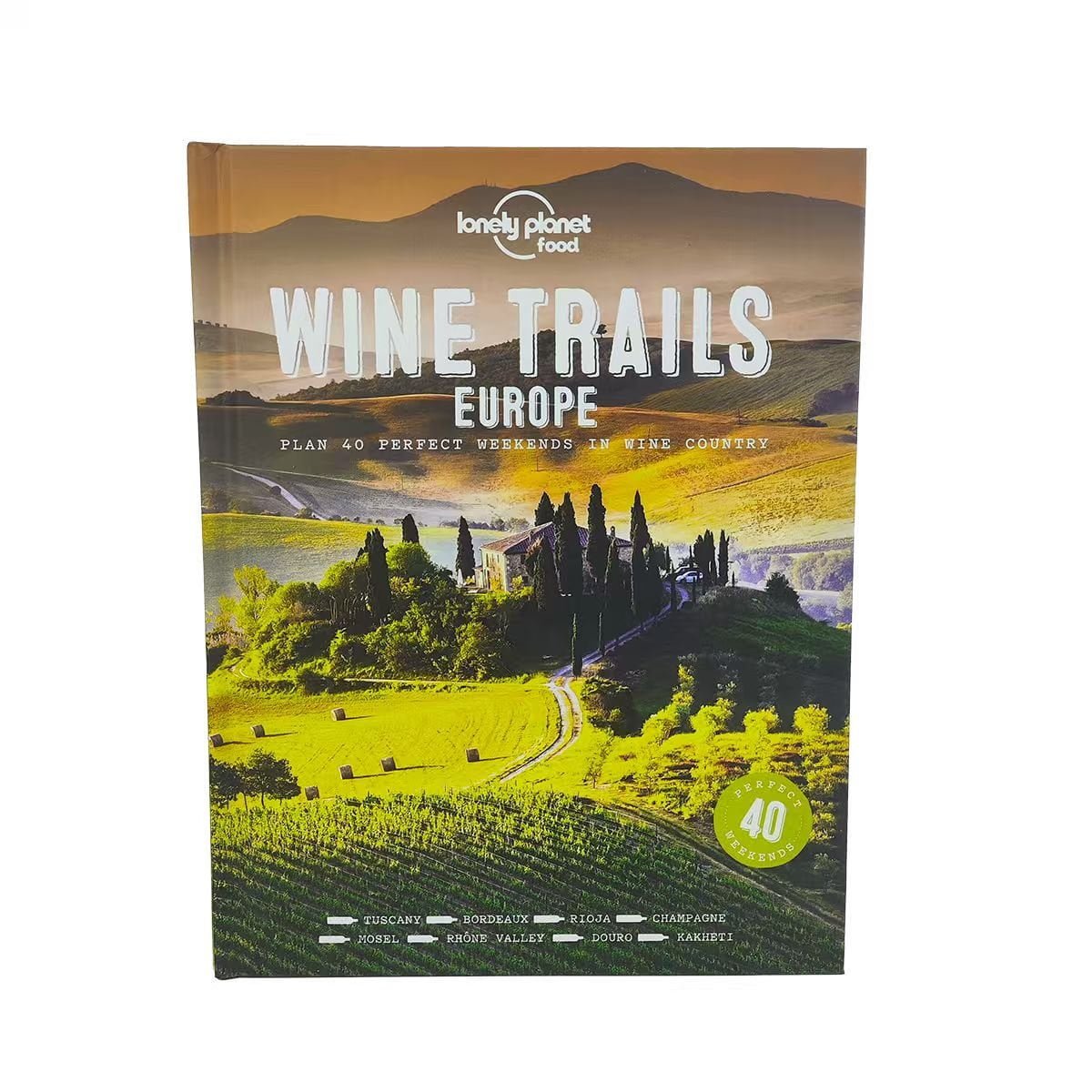
You will see the fastest savings by choosing a standard trim that optimizes paper yield, simplifying finishing, and pressure-testing a 2,000-copy quote. The sections below break down each lever, with definitions, examples from real quotations, and checklists you can use before you request pricing.
What variables drive the cost to print 1,000 books in China?
Choosing specs in the wrong order wastes budget. Many buyers start with cover effects and ignore paper and size utilization. That creates hidden costs and delays. Start with function and unit economics, then layer in options that earn their keep in retail or campaign conversions.
A 1,000-copy China print cost rests on six drivers: paper (30–50% of cost), binding method, trim size (sheet utilization), printing (B&W vs. color and ink coverage), finishing setup fees, and logistics (25–40% of landed). Optimize these first; everything else is secondary.

The six drivers, defined and prioritized
- Paper: Stock, weight (GSM), coating, brand. Typically 30–50% of ex-works/FOB manufacturing cost.[^2]
- Binding: Perfect bound, casebound (hardcover), saddle stitch, Wiro-O, board book—each adds different labor and materials.
- Trim size: How well your page fits the press sheet. Poor “sheet size utilization” wastes 15–20% paper.
- Printing: B&W vs. full color, and “ink density” (heavy coverage/full-bleed dark pages slow presses).
- Finishing: Lamination, spot UV, foil, emboss/deboss—flat setup fees hit 1,000-copy runs hardest.
- Logistics: Ocean freight, trucking, customs, duties. Landed cost can be 25–40% higher than your FOB price[^3].
Key definitions in plain language:
- Makeready: The one-time setup to get the press in color and register[^4]. You pay it regardless of quantity.
- Run-on cost: The marginal cost for each additional copy after setup. This is why 2,000 copies are not 2× the price.
- FOB: Free On Board—price to get goods on the vessel in China.
- CIF: Cost, Insurance, Freight—price including ocean freight to your port, excluding local charges/duties.
From real quotation work, first-time buyers are most surprised by two things: (1) how much paper choice and trim size matter to total cost, and (2) how finishing setup fees distort unit prices at 1,000 copies.
How do paper, size, and binding change your total cost to print 1,000 books in China?
Paper looks simple, but it hides the biggest swings. An odd trim size can waste a fifth of your paper budget. Binding is the second lever: a casebound children’s book can feel premium but doubles casing-in labor and materials.
Prioritize paper utilization and binding efficiency. Use a standard trim that fits common press sheets, match GSM to function, and confirm binding cost steps. These three choices set your base cost before you add any cover effects.
Paper and size: get the yield right
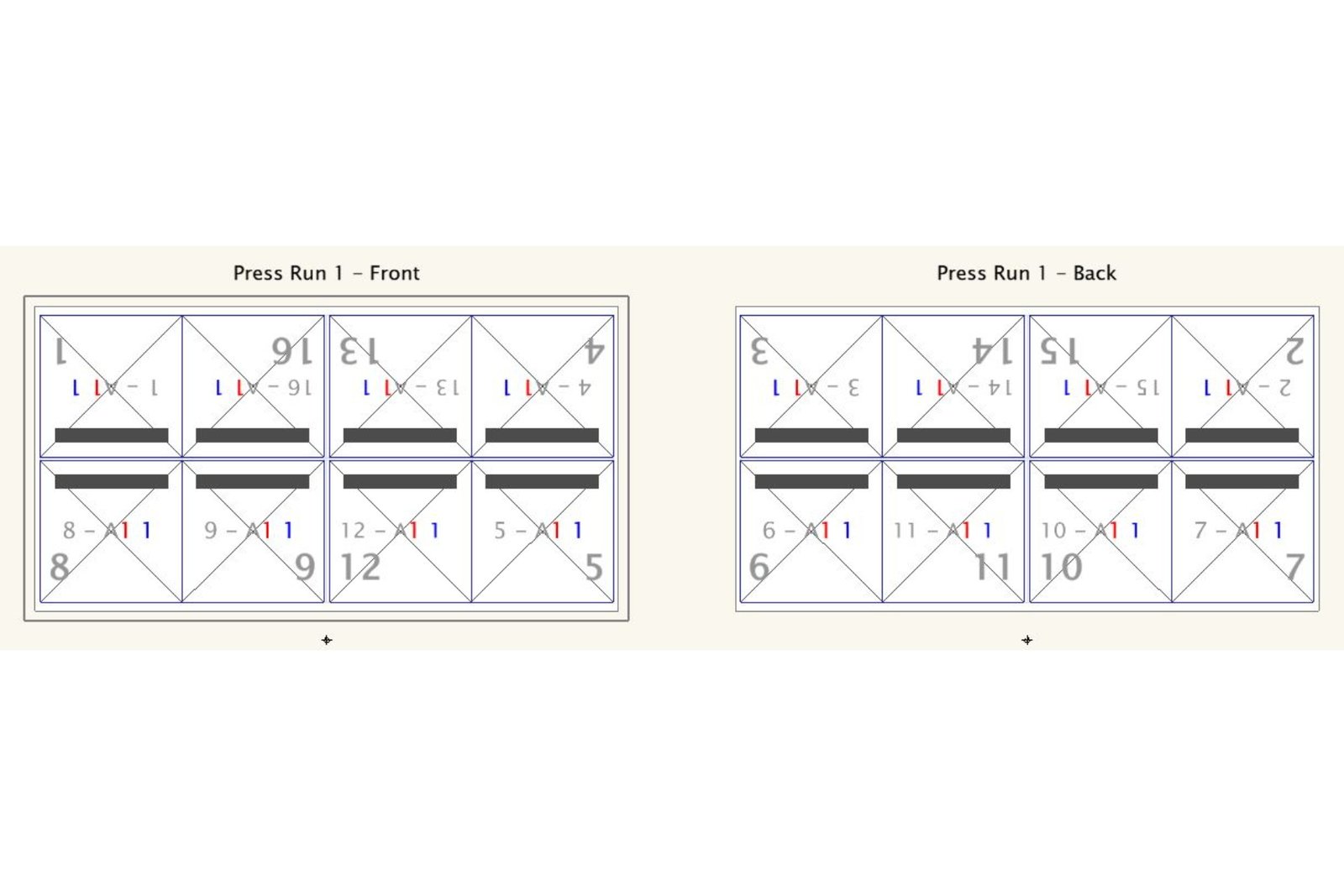
- China commonly uses press sheets like 787×1092 mm or 889×1194 mm[^5].
- A “friendly” trim (for example, 210×280 mm, 148×210 mm A5, or 203×254 mm 8×10 in) can increase the “ups” per sheet.
- Poor utilization = more sheets = higher paper and press time.
Real example from a 1,000-copy color picture book:
- Spec A: 210×280 mm, 32 pages, 157 gsm art paper, perfect bound. Good sheet yield.
- Spec B: 215×280 mm, same internals. That 5 mm change cut an up per sheet in one section. Paper usage rose ~12–15%, raising FOB unit cost by around $0.18–$0.25.
Binding: match durability to use
- Perfect bound (paperback): Economical; ideal for trade, catalogs, many picture books.
- Casebound (hardcover): Premium; higher unit cost due to board, cloth/PVC wrap, endpapers, and casing-in labor.
- Saddle stitch: Cost-effective for low page counts (8–48 pages).
- Wiro-O/spiral: Lay-flat; adds punching and wire; priced above perfect bind.
- Board book: Specialized equipment; thick boards; high material cost.
In a 1,000-copy children’s picture book (32pp, 157 gsm art):
- Switching from perfect bound to casebound increased unit cost by roughly $1.00–$1.30, reflecting cover boards, endsheets, and casing labor. The exact delta depends on cover materials and spine thickness.
Quick table: how choices move manufacturing cost
| Choice | Impact on cost (1,000 copies) | Why it moves the needle |
|---|---|---|
| Trim 210×280 vs 215×280 | +$0.18–$0.25/unit | Fewer ups per sheet = more paper and press time |
| 128 gsm vs 157 gsm text | +$0.12–$0.20/unit | Heavier paper costs more and raises freight weight |
| Perfect bound vs casebound | +$1.00–$1.30/unit | Boards, endsheets, casing-in, slower line speed |
| Matte vs gloss lamination | Similar material; see finishing | Aesthetic choice; matte shows scuffs more (packaging attention) |
Tip: Always ask your printer, “What trim size yields best on your standard sheets for my page count?” That single question often saves more than downgrading paper.
Should you print 2,000 instead of 1,000 to lower unit cost?
Many teams fixate on 1,000 copies to “limit risk,” then discover the unit cost is stubbornly high. This happens because setup is already paid once. Run-on copies are much cheaper. If you can sell through, 2,000 can be the smarter financial decision.
Yes—test a 2,000-copy quote. In many real quotations, 2,000 copies total only 1.4–1.6× the price of 1,000 because makeready and setups are already covered. The unit price drops sharply, sometimes by 25–35% versus 1,000 copies.
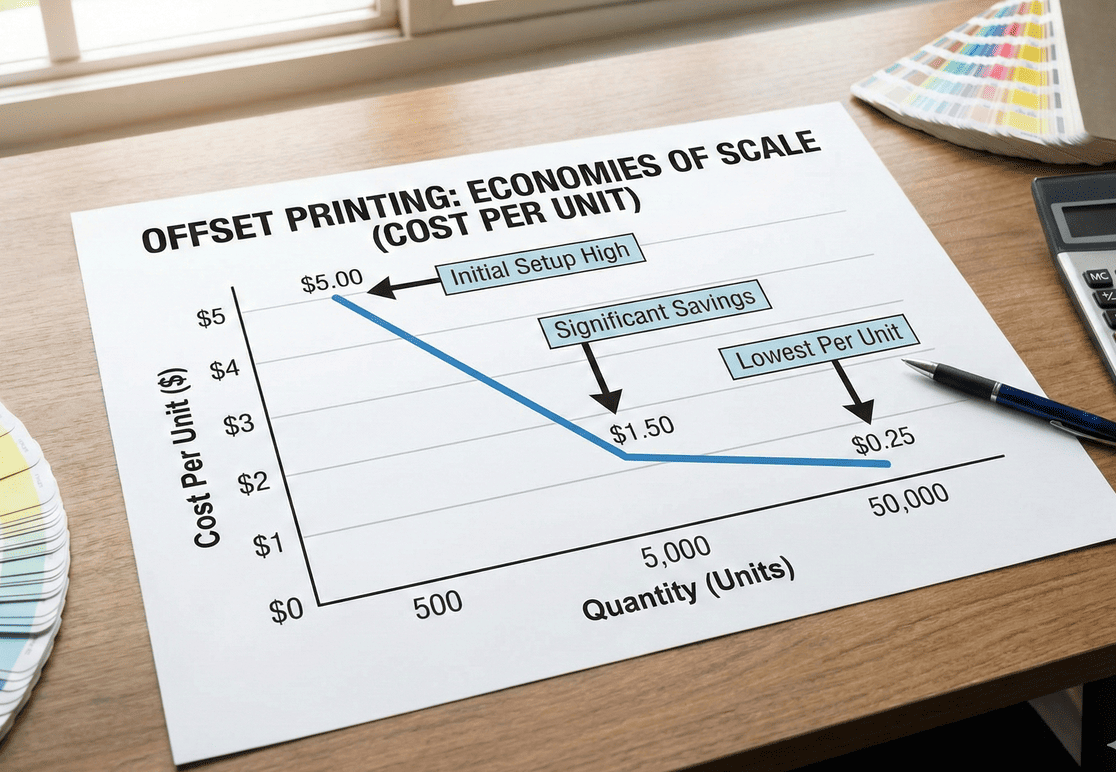
Why 2,000 is often smarter than it sounds
- Makeready: You pay for plate output, color calibration, and press setup once.
- Run-on: Additional sheets run faster and cheaper; binding lines are already tuned.
- Finishing: Setup fees (foil dies, screens, emboss brass) are flat; they dilute over more units.
Real quotation cases:
- 96-page full-color, perfect bound, 170×240 mm, 157 gsm art text, matte lamination cover:
- 1,000 copies: FOB total quoted at ~$5,400–$6,000 (≈$5.40–$6.00/unit).
- 2,000 copies: FOB total quoted at ~1.5× the 1,000 price (≈$8,100–$9,000 total), dropping unit to ≈$4.05–$4.50.
- 32-page children’s picture book, 210×280 mm, 157 gsm text, perfect bound:
- 1,000 copies: FOB ≈$2,300–$2,700.
- 2,000 copies: FOB ≈$3,400–$4,100 (≈1.5×), unit drops from about $2.50 to ~$1.90.
Note: Figures come from real projects in the past two seasons; markets move. Use them as directional anchors, not fixed prices.
Inventory risk vs. savings:
- If you have predictable channels (distributor PO, crowdfunding backers, museum stores), the savings usually outweigh storage costs.
- If demand is uncertain, split the risk: run 2,000, then ship in two waves or stage fulfillment.
Checklist before you decide:
- Confirm run-on price per extra 500 copies.
- Ask about storage options or split shipments.
- Model breakeven: How many extra copies must you sell to cover the additional outlay?
- Consider freight: 2,000 copies may push you from LCL to FCL, lowering freight per unit.
How do shipping and duties affect total cost?
Many buyers focus on the factory quote and forget landed cost. Freight rates, local port charges, and duties can add a quarter to nearly half on top of FOB. You cannot evaluate value until you model logistics to your door.
Expect logistics to add 25–40% to landed cost for books, depending on weight, route, and Incoterms. Sea freight is cheaper but slower; air is fast but expensive. Clarify FOB vs. CIF vs. DDP and get a freight estimate before locking specs.
Incoterms and cost components
- FOB (Free On Board): Factory loads goods onto the vessel. You pay ocean freight, insurance, destination charges, customs, duties, trucking.
- CIF (Cost, Insurance, Freight): Supplier books ocean freight to your port. You still pay destination fees, customs, duties, trucking.
- DDP (Delivered Duty Paid): Supplier handles shipping and import to your address. Convenient but often priced with a premium.
Books are heavy:
- Paper weight drives freight class. A 1,000-copy run of a 96-page perfect-bound book can weigh 900–1,200 kg and take 1.5–2.5 CBM, depending on size and packing.
- Ocean LCL (less than container) has minimum charges; sometimes 2,000 copies approach FCL (full container load) tiers, improving per-unit freight.
Import and compliance:
- HS code for printed books usually carries low duty in many markets[^6], but rules vary. Always confirm with your customs broker.
- Budget destination charges: terminal handling, documentation, customs clearance, and local delivery can surprise first-time importers.
Action steps to avoid overruns:
- Ask for quotes in two formats: FOB and CIF to your nearest port.
- Get a forwarder estimate for your spec’s estimated weight/CBM.
- Add a contingency (10–15%) for rate volatility.
- Confirm who acts as Importer of Record and who carries insurance coverage.
Finishing and packaging affect logistics too:
- Heavy laminate and rigid slipcases add weight and volume.
- Carton design and palletization influence damage rates and chargeable weight.
Frequently Asked Questions
What specs should you prepare before asking for a quote?
Provide trim size, page count, printing (B&W or color), paper types and GSM for cover and text, binding type, finishing (lamination, foil, spot UV, emboss), quantity targets (1,000 and 2,000), delivery term (FOB/CIF/DDP), and destination port. Add use case (retail, crowdfunding, education) to guide durability and packaging decisions.
What is “ink density” and why does it change price?
Ink density describes how much of the page has heavy ink coverage, especially full-bleed dark backgrounds. High coverage requires slower press speeds and tighter color control, increasing makeready and waste. Color-heavy picture books with dark spreads typically cost more than light, white-background layouts.
How can you choose a trim size that reduces paper waste?
Ask the printer which standard sheet size they will run and how many “ups” your book yields per sheet. Choose a trim (e.g., 210×280 mm or 203×254 mm) that maximizes ups with your page count. Small changes (even 3–5 mm) can add 10–20% paper waste on some forms.
How long does a 1,000-copy run usually take?
Typical timelines run 3–5 weeks for manufacturing after files are approved: 3–5 days prepress and proofing, 5–10 days printing, 5–10 days binding/finishing, plus packing. Add shipping: ocean freight is usually 3–6 weeks depending on destination[^7], plus customs and local delivery.
What certifications and quality controls should you verify?
Ask suppliers to provide current certificates and audits such as FSC (paper chain of custody)[^8], ISO 9001 (quality management)[^9], and social audits (e.g., SMETA[^10]). Treat documents as verification items—request copies, check validity dates, and ensure they match the facility that will produce your job.
Conclusion
The cost to print 1,000 books in China is not one number. It is the outcome of choices about paper, binding, size, printing method, finishing, and logistics. Optimize sheet utilization, simplify finishing on short runs, and always model a 2,000-copy scenario—the total often rises only 1.4–1.6× while unit costs fall sharply. The best way to get an accurate price for your specific book is to send your specs to a few factories for a quote.
[^1]: "[PDF] STUDY OF THE ECONOMIC EFFECTS OF TERMINATING THE ...", https://www.usitc.gov/publications/332/pub1402.pdf. In short-run manufacturing, fixed setup and makeready costs represent a disproportionately large share of total production cost, a well-documented principle in industrial economics that applies across printing and other manufacturing processes. Evidence role: general_support; source type: research. Supports: the principle that fixed setup costs represent a larger proportion of total cost in short manufacturing runs. Scope note: General manufacturing economics principle rather than China-specific printing data [^2]: "[PDF] Cost-Estimating For Commercial Digital Printing", https://digitalcommons.calpoly.edu/cgi/viewcontent.cgi?article=1004&context=grc_fac. Industry analyses confirm that substrate (paper) costs typically constitute 30-50% of direct manufacturing costs in commercial book printing, though the exact proportion varies with paper grade, book specifications, and run length. Evidence role: statistic; source type: research. Supports: the proportion of total manufacturing cost attributable to paper substrate in book printing. [^3]: "Publication: Logistics Costs and Competitiveness", https://openknowledge.worldbank.org/entities/publication/121bbfe8-e988-51c3-8b96-0e6126c9593d. International trade studies indicate that landed costs for physical goods imported from China typically exceed FOB prices by 25-40%, accounting for ocean freight, insurance, customs duties, port handling, and final delivery, though actual percentages vary by product weight, route, and destination country tariff schedules. Evidence role: statistic; source type: research. Supports: the typical additional cost from international shipping, insurance, duties, and handling when importing from China. Scope note: General import logistics rather than book-specific data [^4]: "Glossary of Printing & Graphic Terms", http://www.printindustry.com/GLOSSARY.ASPX. In printing industry terminology, makeready refers to all preparation activities required to configure a press for a specific job, including achieving proper ink coverage, color balance, and registration—activities that represent fixed costs regardless of run length. Evidence role: definition; source type: encyclopedia. Supports: the standard industry definition of makeready in printing operations. [^5]: "Paper size - Wikipedia", https://en.wikipedia.org/wiki/Paper_size. Chinese printing standards historically adopted sheet sizes of 787×1092 mm and 889×1194 mm, dimensions that align with both traditional Chinese formats and efficient cutting of international ISO paper sizes. Evidence role: general_support; source type: research. Supports: the standard press sheet dimensions commonly used in Chinese printing facilities. [^6]: "4901.99.00.91 - Harmonized Tariff Schedule", https://hts.usitc.gov/search?query=4901990091. Under the Harmonized System classification, printed books (typically HS codes 4901-4902) benefit from reduced or zero tariff rates in many jurisdictions due to cultural and educational exemptions in trade agreements, though specific duty rates vary by country and book type. Evidence role: general_support; source type: institution. Supports: the typical tariff treatment of printed books under international trade agreements. Scope note: General principle; actual duties depend on specific destination country and current trade agreements [^7]: "A Breakdown of China to USA Shipping Time", https://dimerco.com/blog-post/a-breakdown-of-china-to-usa-shipping-time/. Maritime shipping data indicates that ocean freight from major Chinese ports to North American and European destinations typically requires 3-6 weeks transit time, with variation based on specific route, port pairs, sailing schedules, and whether direct or transshipment service is used. Evidence role: general_support; source type: research. Supports: typical ocean freight transit times from Chinese ports to major international destinations. [^8]: "Chain of Custody Certification", https://fsc.org/en/chain-of-custody. The Forest Stewardship Council (FSC) provides chain-of-custody certification that traces paper products from certified forests through manufacturing to ensure responsible sourcing, a standard widely used in commercial printing to verify sustainable forestry practices. Evidence role: definition; source type: institution. Supports: the purpose and scope of FSC chain-of-custody certification in paper and printing. [^9]: "Quality management systems: An introduction - ISO", https://www.iso.org/quality-management/what-is-qms. ISO 9001, published by the International Organization for Standardization, specifies requirements for quality management systems and is the most widely adopted quality standard globally, used across manufacturing sectors to demonstrate consistent process control and customer focus. Evidence role: definition; source type: institution. Supports: the scope and purpose of ISO 9001 as a quality management standard. [^10]: "SMETA, the world's leading audit - Sedex", https://www.sedex.com/solutions/smeta-audit/. The Sedex Members Ethical Trade Audit (SMETA) is a widely used social audit methodology developed by Sedex to assess labor standards, health and safety, environmental practices, and business ethics in global supply chains, helping buyers verify supplier compliance with ethical trading standards. Evidence role: definition; source type: institution. Supports: the nature and purpose of SMETA audits in supply chain ethics verification.